





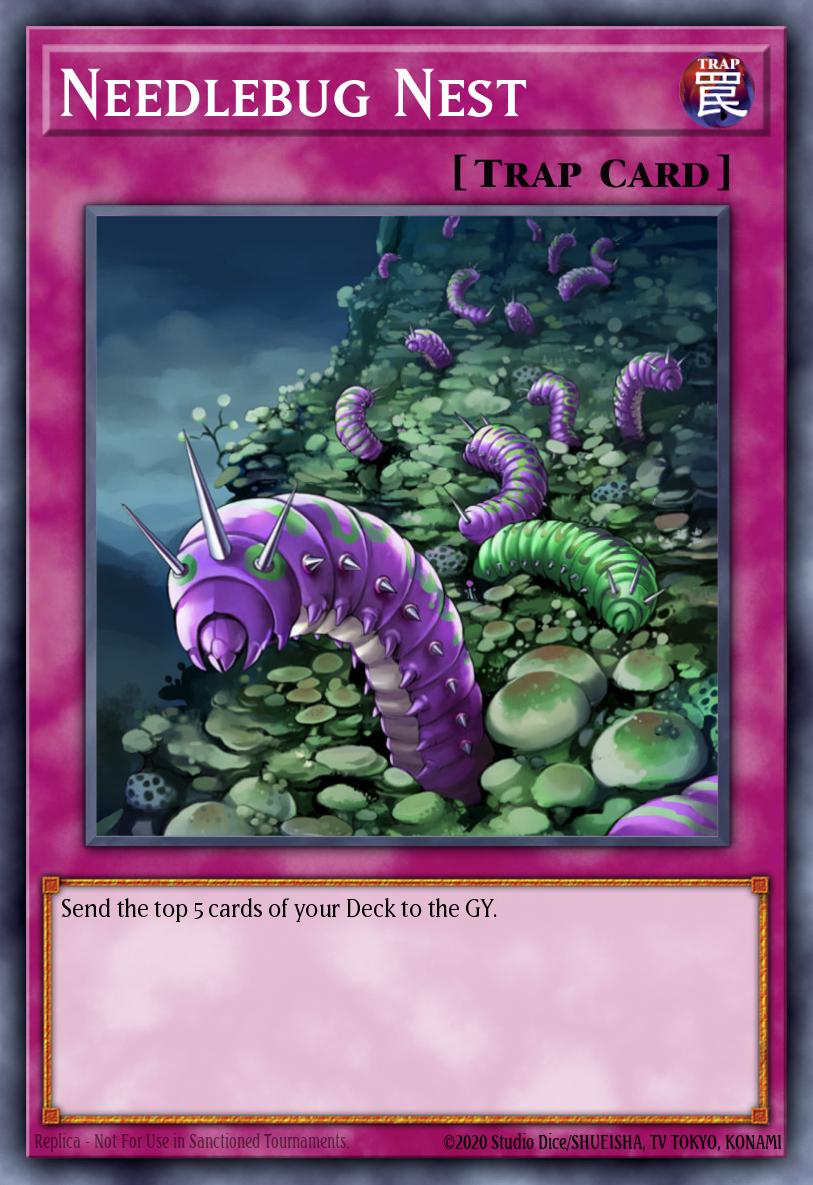


Needlebug Nest — Power Evaluation
Final Score: 59 ± 5 · Confidence: Medium
- Intrinsic: 56 · Deck: 61 · Meta: provisional
- Primary role: Combo enabler · Secondary: Utility, Resource engine
Why it scores here
Needlebug Nest scores as a high-volume, low-interaction mill engine that converts into board advantage exclusively through archetype-specific synergies. In Paleozoic (41% of sampled decks), milling 5 cards triggers trap revivals that generate multiple board bodies; in Tearlaments (17%), it mills fusion materials enabling rapid summons. The card's broad adoption across 51 distinct archetypes confirms strong accessibility, but it produces zero direct disruption or material value—its score reflects that value is entirely downstream. It is a strong enabler, not a power card.
Axis scores
| Axis | Score | Evidence |
|---|---|---|
| Accessibility | 72 | Runs as a 3-copy staple in 335/400 decks with no summon requirement; searchable in Paleozoic core and live across 51 archetypes. (verified) |
| Combo & Conversion | 55 | Milling 5 triggers cascading effects in synergistic homes—trap revivals in Paleozoic, fusion summons in Tearlaments—but produces nothing alone; average extension is moderate. (inferred from text and top partners) |
| Resource Economy | 58 | Milled cards become recursion/fusion targets in homes, yielding roughly +0 to +2 advantage; in isolation, it is −5 net. (observed from archetype synergy partners) |
| Effect & Interaction | 5 | No disruption, removal, negation, or hand-trap capability; purely milling with zero direct opponent interaction. (verified from card text) |
| Material Utility | 2 | Trap card; cannot serve as synchro/fusion/link material; zero intrinsic body value even when blanked. (verified from card type) |
| Resilience & Flexibility | 50 | Once activated, milling resolves cleanly without interrupt; trap-zone vulnerability is standard; no OPT clause allows multiple activations if set multiple times. (verified from card text) |
| Deck-Building Efficiency | 68 | Runs 3 copies across 51 archetypes with no locks or restrictions, making it a clean and splashable staple with high redundancy value. (verified from deck evidence) |
Calculation
Weight profile: 0.7 Combo enabler + 0.3 Utility. Intrinsic ≈ 56, Deck ≈ 61, Meta = provisional. Modifiers: none. Final formula: 0.40*Intrinsic + 0.60*Deck
Strengths
- 3-copy staple with zero brick risk across 51 distinct archetypes and multiple gameplays
- Core engine piece in Paleozoic (41% of decks), triggering trap revival chains for cascading board presence
- Enables rapid fusion summoning in Tearlaments by milling fusion materials and synergy cards
- Clean trap activation that resolves without interrupt once set
- Highly splashable across control (58.5%) and combo (38.8%) strategies without deck locks
Weaknesses
- Zero direct opponent interaction, removal, negation, or disruption capability
- Produces no combat value and contributes no board presence when activated alone
- Card advantage is entirely dependent on archetype (−5 in isolation, +0 to +2 in synergistic homes)
- Vulnerable as a set trap to trap destruction (Cosmic Cyclone, Twin Twisters, Harpie's Feather Duster)
- No player control over which 5 cards are milled; inherent deck variance creates occasional dead mills
Counters / choke points
- Trap destruction effects during the set phase or after activation
- Archetypes that do not benefit from graveyard milling or have critical on-field-only effects
- Decks where milled cards clog GY recursion targets (e.g., decks with limited GY space)
Best use
Milling engine to trigger trap revivals, fusion summons, and graveyard-activated effects. Decks: Paleozoic, Tearlaments, Kashtira, D/D/D, Danger!. Suggested copies: 3.
Evidence & gaps
- Verified: Card text: 'Send the top 5 cards of your Deck to the GY.' (card.description); Runs in 400 sampled decks, average 2.77 copies, modal run of 3 copies in 335 decks (83.75%) (deck data.copies per deck); Appears across 51 distinct archetypes (deck data.distinct archetypes); Primary archetype: Paleozoic at 41.3% of deck sample (27.5% + 13.8%) (deck data.archetypes); Top partners are trap-revival cards: Paleozoic Marrella (76.2%), Dinomischus (73.2%), Opabinia (73.2%), Transaction Rollback (84.2%) (deck data.top partners); Legal in TCG, OCG, MasterDuel, DuelLinks; limited to 1 copy in DuelLinks (card.formats, card.legal copies); Trap card type; cannot serve as synchro/fusion/link material (card.type, card.card frame); No once-per-turn restriction in card text (card.description); Not a top-ranked card across formats (top-card data.top-card status = false)
- Observed: Paleozoic is dominant home: 41.3% of 400 decks ≈ 165 decks; Tearlaments 16.7% ≈ 67 decks; secondary homes total ~50 more decks (deck data.archetypes); Mostly run in control (58.5% of decks) and combo (38.8%) gameplays (deck data.formats); Guardragon archetype statistics: 100% inclusion at 3 copies (usage statistics); Co-deck rates with Paleozoic cards (70-84%) confirm trap-revival synergy is primary driver (deck data.top partners)
- Inferred: Primary role: Combo enabler—mills 5 cards to fuel trap revivals and fusion effects across multiple homes; In Paleozoic, milling triggers trap revivals (Marrella, Dinomischus, Olenoides, Opabinia) creating cascading board presence and recursion chains; In Tearlaments, milling sends fusion-material monsters to GY, enabling rapid Tearlament fusion summons; Generic utility: 51 distinct archetypes running this card suggests broad applicability beyond core homes; Deckbuilding efficiency: runs as 3-copy staple without locking mechanics, indicating clean splashability; Resource economy in synergistic homes: milled cards with GY effects (Paleozoic revival, Tearlament fusion) create net advantage; milled cards without GY effects create net disadvantage
- Data gaps: No combo boards recorded (0 combos)—combo_conversion and board-building sequences are text-only inference, not empirically corroborated by recorded combo games Guides are sparse (5 total) and reference the card in passing within broader archetype guides rather than dedicated analysis No top-card ranking or metagame tier provided, preventing competitive-context calibration No ruled edge cases or exotic timing interactions documented (e.g., interaction with Future Fusion, Shaddoll effects, or Tearlament-specific mills)